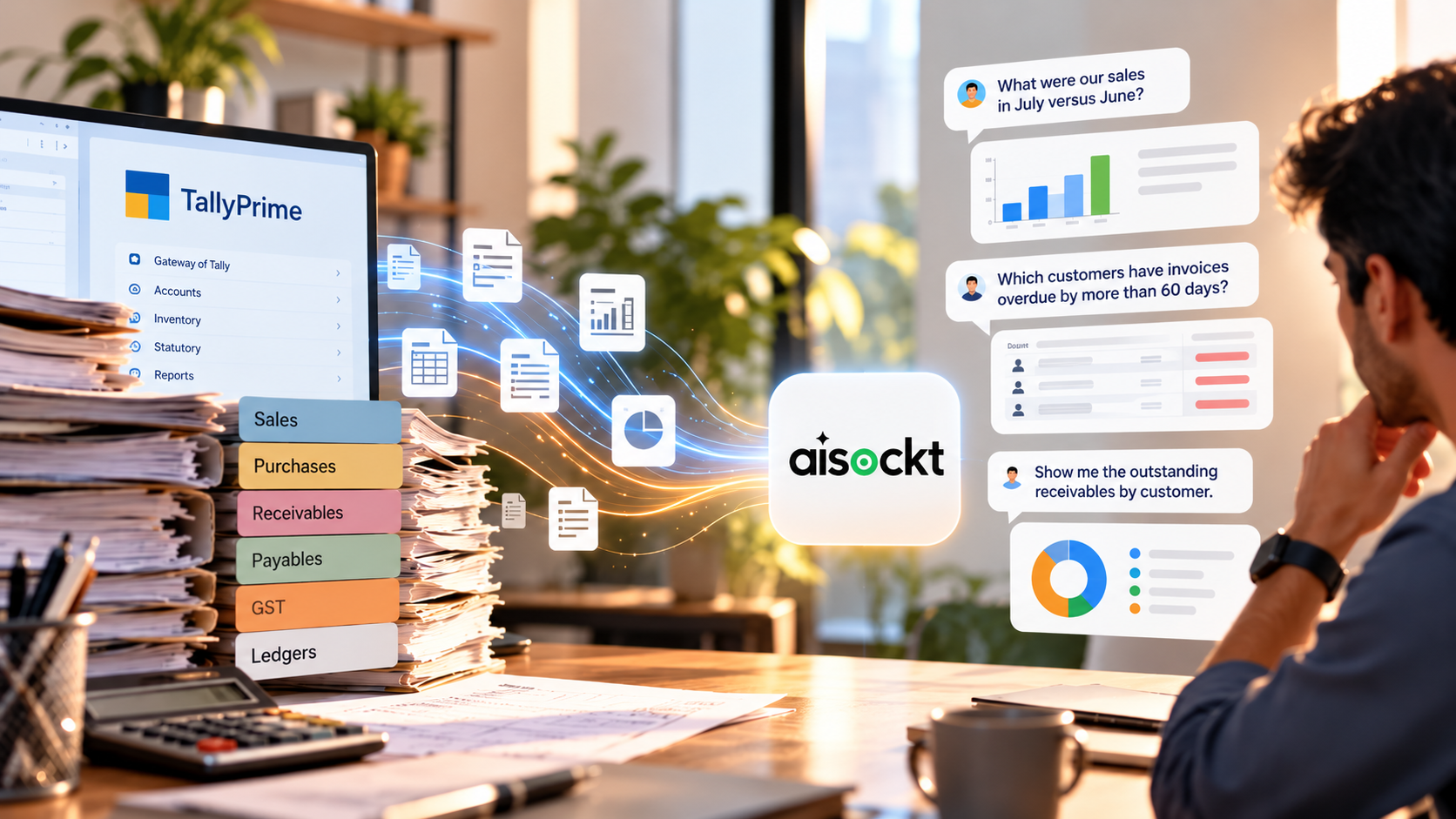


Most businesses don't have a shortage of data.
If anything, they have too much of it. Invoices, payments, customer records, employee details, sales information, it's all there somewhere. The frustrating part is finding the right piece of information when you actually need it. The information is there. So why does it take so long? Let's take Tally Prime as an example. You may want to know:
"How many invoices are still unpaid?"
The answer is already sitting in the system.
But getting to it may mean opening Tally, finding the right report, selecting the relevant options, applying filters, checking the results, and sometimes exporting information before you can work with it.
None of these steps are particularly difficult. There are just a lot of them. And when the same thing happens repeatedly, it becomes time-consuming.
The problem isn't Tally
Tally is doing what it is supposed to do. The same is true for other business applications. The problem is that employees often have to learn how the system stores and displays information before they can get the answer they want. But that's not how people normally think about their work. They don't think:
"I need to open this report and apply this filter."
They think:
"I need to know which invoices are unpaid."
There is a difference. What if the system understood the question instead? This is where connectors can be useful. A connector creates a link between an AI application and a business application. Tools then provide predefined ways for the AI to retrieve the information it needs. So the employee can start with the question rather than the software. For example:
"Show me the unpaid invoices from this month."
The LLM understands the request. The relevant tool is selected. The connector works with the connected business application. The required information is retrieved. And the answer comes back through the chat. The user doesn't have to figure out where the information is stored first.
This is what AiSockt is built around
AiSockt brings these pieces together through a conversational interface. Instead of making users learn a new way to search for every piece of business information, AiSockt lets them ask questions in natural language. The connectors help connect AiSockt to business applications. The predefined tools help it retrieve specific information. And the chat gives the user a simple place to ask.
For example, if a business has the appropriate Tally Prime connector and tools available, a user could ask:
"Show me the invoices that are more than 30 days overdue."
The user doesn't need to manually search through every invoice. They ask the question, and AiSockt uses the available tools to retrieve the relevant information.
One question can replace several steps
This doesn't mean every task suddenly becomes automatic. It means the starting point becomes much simpler. Instead of:
Open application → find section → select report → apply filter → search → check result the experience can become:
Ask → retrieve → answer
That's a meaningful change when the same searches happen again and again.
Why this can be useful for teams
The benefit isn't limited to finance teams. Any business function that regularly works with information stored in connected applications can potentially benefit from a simpler way to access that information. The exact use cases depend on the connectors and tools available. But the idea stays the same:
The business already has the data. People just need an easier way to get to it. That's where AiSockt comes in. It doesn't ask businesses to throw away the systems they already use. It connects the conversation to those systems, so employees can start with what they actually know, the question they want answered. And when finding information takes less time, people have more time to do something with it.